Search for a Location
Newsstands for Events and Brand Activation: A New Life for Urban Spaces
Event kiosks allow a brand to connect with the public in a space that is already part of city life. They can host pop-ups, presentations, and editorial projects, provided their size, location, and intended use are compatible with the initiative. Their appeal stems from their connection to the street: a familiar place takes on a new function and invites people to stop by.
In Milan, projects such as the takeover of Cabana in Piazza Santo Stefano and the events at nss edicola in Piazza Bruno Buozzi showcase two ways of interpreting this transformation. The newsstand retains its distinctive character and becomes a meeting point for culture, products, and people. It is this potential that has sparked interest in a format different from traditional showrooms and exhibition spaces.
From selling newspapers to a new way of experiencing the city
A newsstand occupies a unique place in the urban landscape. It faces the crosswalk, displays its offerings to the outside world, and facilitates interaction without the barrier of a storefront. The act of approaching, looking, and asking for information is already part of its original function.
When a space hosts a selection of magazines, an exhibition, or a brand project, this sense of familiarity can make it easier for people to connect. Reuse, therefore, also affects the way people experience the space: a retail location can become a stop on a cultural journey or an opportunity to discover a product.
These transformations can be permanent or limited to the duration of a campaign. In some cases, publishing remains central; in others, the kiosk temporarily hosts a visual identity and a dedicated program. For organizers, understanding this difference is essential: collaborating with an existing cultural institution requires a different approach than setting up a space for temporary use.
Cabana and nss newsstand: two real-life examples in Milan
Cabana in Piazza Santo Stefano
From June 20 to 24, 2025, during Fashion Week, Cabana reimagined Edicolina, located at Piazza Santo Stefano 6, with a takeover dedicated to its editorial universe. The official announcement It featured a selection of issues of the magazine, books, and the Milan City Guide, in a display centered around prints and decorative motifs.
The project established a connection between the space and what was on display there: a publication focused on design and the culture of living engaged the public through a venue historically dedicated to print media. The significance of this project lies in this coherence, as well as in the visual transformation of the newsstand.
NSS Newsstand in Piazza Bruno Buozzi
On April 19, 2026, the nss edicola community gathered in Piazza Bruno Buozzi for the launch of Edicola Italiana, the project’s first free newspaper. In the report published by NSS The following day, the article also discusses Italian newsstands that have taken on hybrid roles combining commerce, culture, and social interaction.
Here, the launch of editorial content becomes a live event. The relationship with the audience revolves around a shared space and a shared interest: the newsstand is part of the experience, along with the publication and the people who follow it.
Cabana and nss are examples from outside the ASK4Location portfolio. They help illustrate the format’s potential: an activation can be successful when the space, the content, and the audience share a recognizable connection—without having to scale down an event originally designed for a much larger venue.
Why Choose a Newsstand for a Brand Activation
A brand activation is an initiative that facilitates interaction between a brand and its audience. At a newsstand, this interaction can be very immediate: discovering a publication, browsing a selection of products, picking up a brochure, or attending a brief presentation.
The project must be understandable even to those who hadn’t planned to participate. What do you see when approaching from the street? What elements invite you to come closer? What can a person do once they reach the counter? Answering these questions helps define an accessible experience, rather than relying solely on the design of the facade.
The neighborhood also plays a role in the decision. Pedestrian traffic, nearby businesses, and operating hours all shape the context of the initiative. A central location may be appealing, but it must be evaluated in relation to the target audience and the actual likelihood that people will stop by. Visibility alone does not determine the quality of the interaction.
What kinds of projects can be featured at a newsstand?
This format lends itself to compact initiatives, with few display elements and a clear main focus. A book launch can center around a single publication; a product presentation can use the display counter as the primary point of discovery; and a pop-up store can feature a limited selection, tailored to the available space.
Another possibility involves photo shoots and video productions: the kiosk’s structure, its openings, and its relationship with the surrounding buildings can contribute to the composition of the images. In this case, the assessment also takes into account lighting, camera angles, the presence of passersby, and the space required for the crew.
These are scenarios that need to be worked out based on each individual brief. Sales, sample distribution, filming, or use of the outdoor area require specific assessments: the presence of a counter or a canopy alone is not enough to determine which activities are permitted.
Newsstands are added to the ASK4Location catalog
ASK4Location has introduced a category dedicated to newsstands, which allows you to explore this category through the individual space listings. For a brand or agency, this is a practical starting point: based on the images and features listed, you can move on to a targeted request, specifying your goals, timeframe, and operational needs.
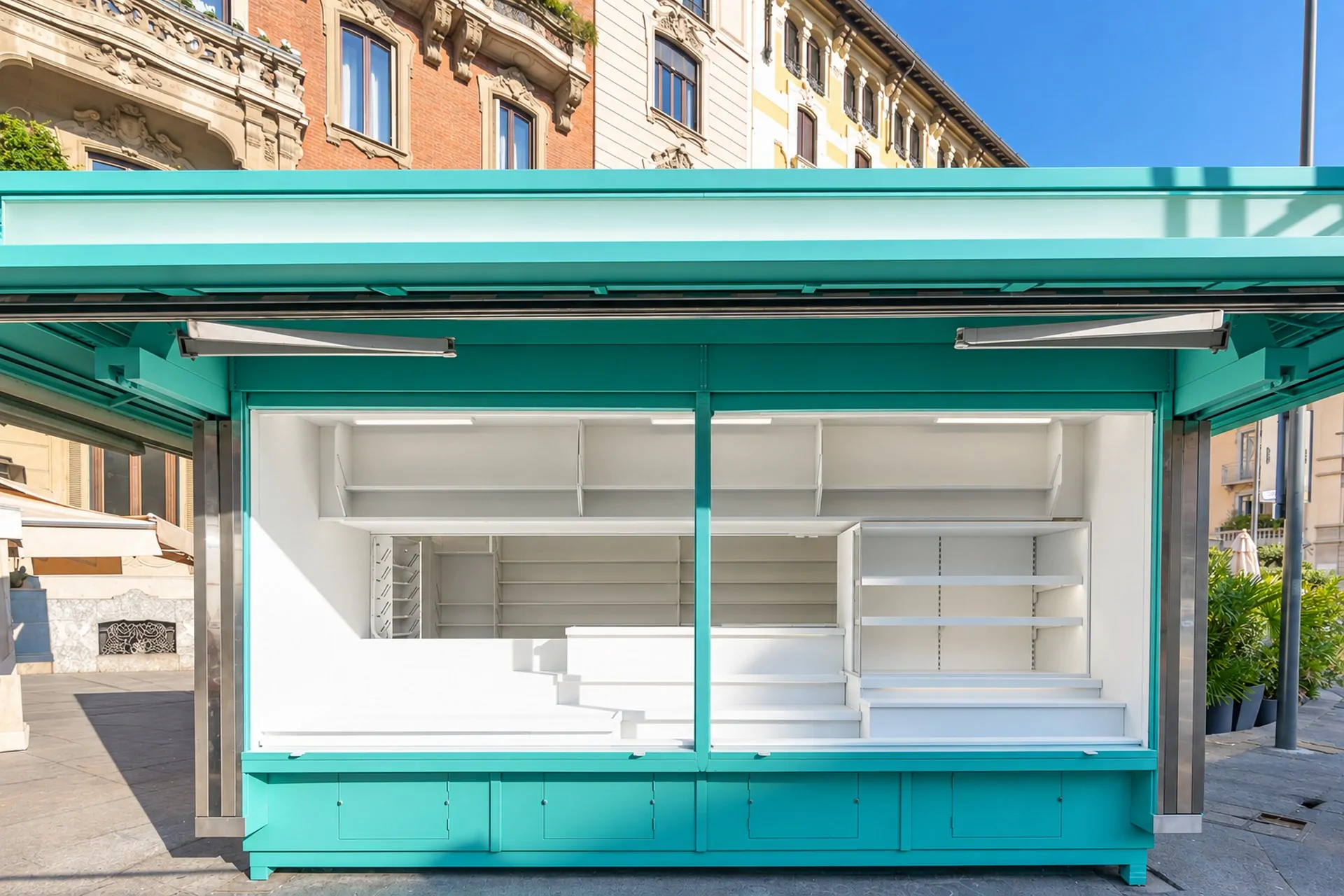
The’The Carlyles' Newsstand, listed in the catalog as located in the province of Milan, features a teal structure, white shelves, and openings facing the street. The listing suggests it for temporary events, product launches, and productions: a useful example for evaluating the relationship between display areas, lighting, and the identity of the space.
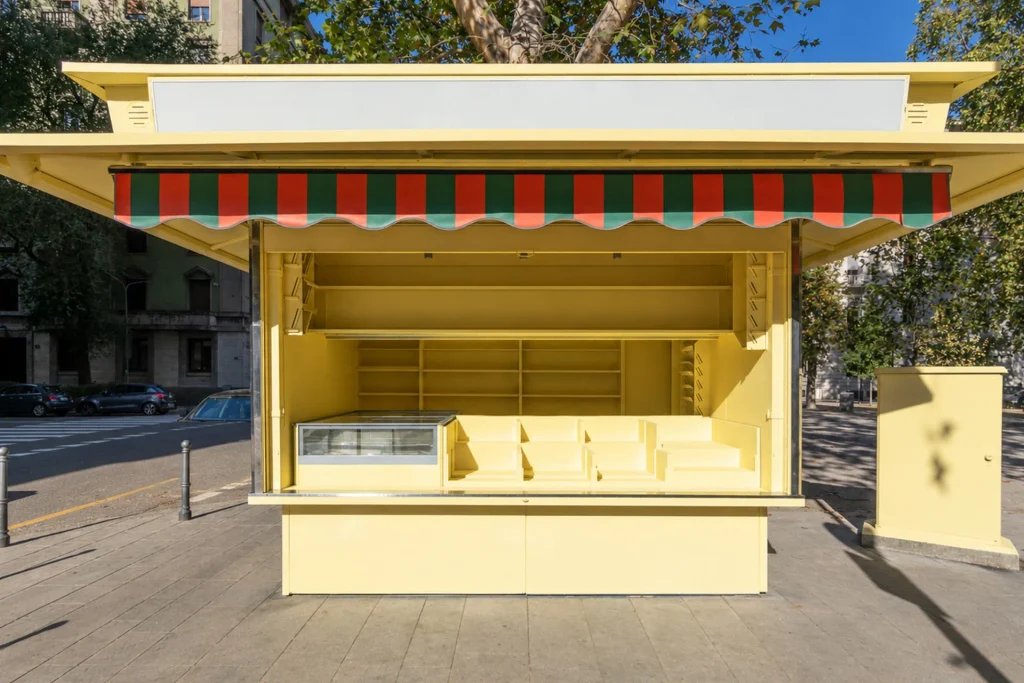
The’Rochefort Newsstand In contrast, it features a yellow finish, a striped curtain, and a counter that opens outward. The color and layout of the storefront provide a different visual cue. Comparing the two profiles helps illustrate how much a venue’s identity can influence its design, even before any brand elements are added.
This selection does not replace an on-site inspection or a review of the project. Availability, usable dimensions, customization options, and access conditions should be discussed in detail with the team for the chosen location.
How to Assess the Space Before Designing the Layout
Interaction with the audience
The first consideration is what happens in front of the newsstand. A quick pickup, a conversation with a staff member, and a demonstration each involve different dwell times. Consequently, this affects the number of people to be managed at the same time, the layout of materials, and any waiting time. The outdoor space must be taken into account from the very beginning of the project, without assuming that all of it is usable.
Technical Requirements
It is necessary to verify the dimensions of the booth, the opening of the doors, display areas, storage space, and access points for materials. Electrical power and internet connectivity must be confirmed based on the intended use. If the event takes place outdoors, it is also necessary to assess the impact of inclement weather on products, equipment, and the comfort of the public.
Customization Options and How to Use Them
Adhesive graphics, signs, displays, lighting, and surface modifications must be approved prior to production. The same applies to music, filming, and activities in the surrounding area. Feasibility is assessed in consultation with the venue manager and any relevant authorities, based on the actual project plan.
Assembly, Management, and Return
Even a short-term event requires preparation time. You need to plan for supplier arrival, unloading, setup, staffing during the event, and final cleanup. When comparing quotes, it’s helpful to distinguish between the use of the space and the event setup, staffing, and other requested services.
From the brief to choosing a newsstand
To begin the scouting process, you’ll need the details of the initiative, the target audience, the dates and duration, the city, the budget, and the main setup requirements. A description of the planned interaction is particularly helpful: it allows you to determine whether the newsstand format is suitable and what features to look for.
ASK4Location assists with the search for spaces and offers support services the preparation of productions and events. The activities required for the project must be specified in the brief and the estimate, in order to clarify the scope of the project.
Explore the newsstands in the catalog e Contact the ASK4Location team With your idea: the goal, timeframe, and method of use are the starting point for identifying the areas to explore further.
FAQ
What are "event newsstands"?
These are venues that can be considered for temporary initiatives such as pop-ups, presentations, publishing projects, and productions. Their specific use depends on the characteristics of the space and the terms agreed upon for each individual project.
Is a newsstand suitable for any brand activation?
It is recommended when the experience can be developed in a compact space, with clear interaction and a design compatible with the urban context. If large open areas, numerous stations, or complex routes are required, a different design approach should be considered.
Can the newsstands in the catalog be customized?
Customization options must be verified for each facility. Before producing graphics or furnishings, it is necessary to agree on usable surfaces, installation methods, and restoration procedures.
How much does it cost to rent a newsstand for an event?
The quote depends on the venue, dates, duration, and planned activities. Setup, staff, and services can affect the total cost; it’s best to request a proposal that specifies the individual items included.
Where can I see the newsstands listed by ASK4Location?
In the Category: Newsstands In the ASK4Location catalog, you can view the product sheets and submit a request. To compare your options, specify the type of project, the timeframe, and your operational requirements.
sidebar-block
WHAT ARE YOU LOOKING FOR?

Are you looking for trendy locations in Sardinia with a sea view to shoot a music video?
Are you looking for exotic, luxury locations to shoot a movie?
Are you looking for ideas for a vintage loft in Milan to shoot a commercial?
sidebar-block
HOW WE CAN HELP YOU
Find out how to transform a historic villa into a dream setting for a film production
How do you choose the perfect apartment for a video production?
Are you looking for a prestigious location for a photo shoot in Milan?